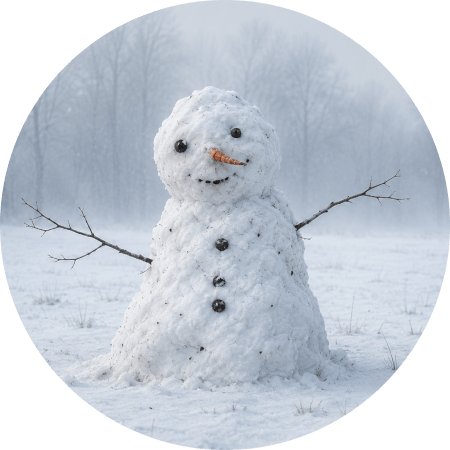
When the Ugly Snowman Melts
In the puddle left behind, there are reflections of parts, wholes, and borrowed shapes.
/* I haven’t seen snow for several years now.
Honestly, I don’t miss it much. Snow is beautiful in the mountains, or from the comfort of a warm room, but ordinary winter comes with many less idyllic details.
Still, I keep thinking about snowflakes.
Their fragile beauty made a small avalanche, and somehow it rolled all the way into this essay. */
Table of Contents:
1 The World’s Ugliest Snowflake
2 The Snowman Problem
3 The Well-Labelled Pantry
4 Borrowed Shapes
5 The Thaw Mirror
6 Can a Snowflake Forget?
The World’s Ugliest Snowflake
Can you build a beautiful snowman using only ugly snowflakes?
At first, the question sounds almost childish. Snowflakes are supposed to be beautiful. They decorate Christmas cards, settle gently on scarves, and appear under microscopes as tiny works of geometric perfection. We admire their symmetry and marvel at the old saying that no two are exactly alike.
But there are also the ugly ones.
Bent crystals. Broken branches. Crooked patterns. Imperfect little flakes that would never become the wallpaper on someone’s desktop or the design on a coffee mug.
Could they still become a beautiful snowman?
Most of us answer yes without hesitation.
Curiously, we don’t feel the need to inspect every snowflake before making that judgement. We somehow know that the beauty of the snowman does not depend on the beauty of each individual flake.
The opposite is equally true.
Perfectly beautiful snowflakes can still make an ugly snowman.
Beautiful parts do not guarantee a beautiful whole.
Ugly parts do not prevent one.
Somewhere between falling from the sky and becoming something together, something changes.
That simple observation conceals a surprisingly deep question.
When does a collection of parts become something else entirely?
The Snowman Problem
More than two thousand years ago, Aristotle noticed the same puzzle. The whole, he argued, is something besides its parts.
It is one of those deceptively simple ideas that keeps resurfacing in places where nobody expects it.
Today, complexity scientists call it emergence. They study how interactions between simple components give rise to properties that none of those components possess in isolation.
Hydrogen burns. Oxygen supports combustion. React them in the right proportion and they form water. Yet neither the elements nor a solitary water molecule is wet. Wetness appears only when many molecules interact.
A single musical note is not a symphony. A letter is not a novel. One neuron is not a thought. One citizen is not a city.
Some qualities seem to exist only when relationships begin.
The parts remain the same. No new ingredient has been added. What changes is the relationship between them. Yet from that change, something entirely new appears.
About a century ago, the Gestalt psychologists approached the same mystery from the opposite direction. Instead of asking how wholes come into being, they asked how we perceive them.
Their conclusion was remarkably similar.
We don’t first observe individual brushstrokes and then calculate a painting.
We see the painting.
We don’t examine every note before hearing a melody.
We hear the melody.
And we certainly don’t admire a snowman one snowflake at a time.
We admire the snowman.
The whole arrives first. Only afterwards do we notice the parts that made it possible.
The surprise is not that the parts change. The surprise is that their relationships create something no examination of the parts alone could predict.
Perhaps this is why the snowman feels so obvious.
Not because it is simple.
Because our minds have been quietly solving this problem all along.
The Well-Labelled Pantry
My grandmother used to keep shelves full of homemade preserves. Neatly arranged, every jar carried a handwritten label. Plum. Apricot. Sour cherry. Rosehip.
Sometimes I think knowledge works much the same way.
Over the centuries, we’ve built an enormous pantry of ideas. Every discipline carefully labels its own jars: chemistry, biology, psychology, economics, philosophy, neuroscience. The handwriting changes. The recipes differ. Yet every so often, you open another jar and discover a strangely familiar flavour.
Chemists describe how simple elements combine into substances with entirely new properties. Biologists watch individual cells organise themselves into living organisms. Economists observe markets behaving in ways no single buyer or seller intends. Neuroscientists continue to wrestle with perhaps the greatest example of all: how billions of neurons give rise to the singular experience we call consciousness.
At first glance, these appear to be completely different questions.
Different departments.
Different journals.
Different conferences.
Different terminology.
Yet they keep meeting at the same crossroads.
The names already encountered around our snowman are only a few labels on those shelves.
Aristotle spoke of wholes possessing qualities beyond their parts.
Gestalt psychologists described how perception favours organised wholes over isolated pieces.
Complexity scientists discuss emergence.
Systems theorists explore how interactions create behaviour that cannot be explained by studying individual components alone.
Different labels.
Different jars.
And, now and then, remarkably similar preserves.
Each points towards the same underlying puzzle.
When does a collection stop being merely a collection?
Or perhaps more intriguingly, when does ‘many’ become ‘one’?
We don’t need to look only at external plurals.
Sometimes the many exists within the one.
Borrowed Shapes
Across the world, stories are filled with beings who change shapes.
Kitsune walk among humans, slipping effortlessly between fox and woman. Selkies leave their sealskins behind to live on land, forever belonging to two worlds and never entirely to either.
Perhaps that is why shapeshifters appear in so many cultures.
They are rarely just stories about changing appearance.
They ask a much older question.
If the shape changes, what remains the same?
A snowman is, in its own quiet way, another borrowed shape.
The snowflakes never stop being snowflakes.
Nothing within them suddenly becomes “snowman”.
The snowman exists only because countless snowflakes agree, for a little while, to relate to one another in a particular way. Together, they become something none of them could have been alone.
Break those relationships, and the snowman disappears without leaving behind a single “snowman particle”.
The shape was always borrowed.
Perhaps we do the same.
We borrow the shape of a student.
A citizen.
A parent.
A friend.
A designer.
A writer.
A leader.
Some roles last only a few hours.
Others accompany us for decades.
Children seem to understand this instinctively. When they play, they do not merely imitate astronauts, dragons or queens. For a little while, they become them. Imagination is a kind of shapeshifting, and perhaps that is why childhood wears its borrowed identities so effortlessly.
As adults, we become more careful with such transformations.
But we still borrow shapes.
We simply call them professions, responsibilities, relationships or titles.
We often ask whether an actor is convincing in a role.
We ask how they prepared for it.
Far less often, we ask what the role left behind.
Does a role change the actor?
Or does the actor change the role?
Perhaps the answer has always been both.
Every role leaves traces.
Not only on actors.
On all of us.
If so, then something unexpected follows.
Perhaps the relationship between parts and wholes has never been one-way.
The Thaw Mirror
Until now, every question has pointed in the same direction.
What happens when parts become a whole?
But snowmen have an inconvenient habit.
They melt.
Eventually, every borrowed shape comes to an end.
The orchestra packs away its instruments. The theatre empties. The company closes its doors. Children leave home. Friendships fade. Empires become chapters in history books.
The whole disappears.
The parts remain.
At least, that is how it seems.
We readily accept that a whole can possess qualities its parts never had. A snowman can be beautiful, even if every individual snowflake is ordinary. A symphony can move us, although no single note ever could.
But once the whole exists, it enters the lives of its own parts.
Can it change them in return?
There is an interesting claim that water can remember what has happened to it — that beautiful crystals appear after kind words, distorted ones after harshness. It continues to fascinate people because it touches a question we recognise.
What trace does participation leave?
How deep can that trace go?
Water may or may not remember.
People certainly do.
Nobody passes through childhood unchanged.
Or friendship.
Or love.
Or grief.
Or parenthood.
Or war.
We often speak about wars as though nations fight them and nations win them.
But nations do not mourn.
People do.
A mother who loses her son on the victorious side carries no lighter a grief than a mother whose son fought for the defeated one.
Beneath the visible layer of win or loss moves the unseen cloud of pain, fear and sorrow that covers everyone involved.
Victory belongs to the whole.
Loss belongs to the parts.
Eventually, the war ends.
The nation returns to ordinary life.
The soldiers return home.
None of them returns as the person who left.
The whole has disappeared.
Yet something of it continues to exist inside those who once belonged to it.
Perhaps this has always been true.
Not only of wars.
Of every whole we have ever inhabited.
Can a Snowflake Forget?
The first question was easy.
Can ugly snowflakes make a beautiful snowman?
The last question is considerably more difficult.
When the snowman melts, do the snowflakes become what they were before?
Physics has its own answers.
Chemistry has its own answers.
Perhaps philosophy does too.
I am not sure any of them are entirely satisfying.
Because by now, we are no longer talking about snow.
We are talking about every conversation that changed us.
Every teacher.
Every book.
Every city.
Every language we learnt.
Every person we loved.
Every version of ourselves we eventually outgrew.
Some wholes last a lifetime.
Others only an afternoon.
Yet each can leave behind something strangely disproportionate to the time it occupied.
Perhaps this is why endings are rarely as clean as they appear.
A concert finishes, but the melody follows us home.
A book closes, yet its characters continue speaking somewhere in the background of our thoughts.
Children leave home, but home never quite leaves them.
The snowman melts.
The shape disappears.
The water remains.
What it carries with it, I cannot say.
But it has belonged to something that did not exist before and will never exist in quite the same way again.
Perhaps that is all a whole has ever been.
A temporary agreement between countless smaller things to become, for a little while, something none of them could have become alone.
And perhaps the most interesting question was never whether ugly snowflakes can make a beautiful snowman.
They clearly can.
The more difficult question is whether, after being part of a snowman, a snowflake can ever become just a snowflake again.
 © Alexandra Mark
 © Alexandra Mark