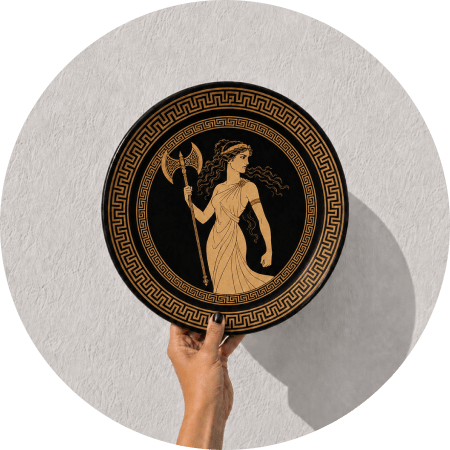
A Confused Bull & Sirtaki
The bull was accused of entering the china shop carelessly.
The human made a reservation.
/* Have you ever imagined walking, perfectly dignified, into a china shop with the sole and entirely intentional purpose of shattering everything inside?
Not someone else’s china shop. That would be criminal damage — not to mention an utter inconvenience for the owner.
A dedicated shop. For you.
You enter as though you are about to receive a Grand Prix. Composed. Upright. Perhaps dressed in something that moves well.
A momentary embodiment of Lyssa, the Greek goddess of rage and fury.
You pause for the invisible photographers.
Then the protective goggles go on.
You lift the first plate with both hands, ceremoniously, as though offering it to the gods. And then you twirl around like a ballerina or a drunk clown.
The sound matters.
The irreversibility matters.
Perhaps even the beauty matters. */
Table of Contents:
1 Misplaced on Purpose
2 The Matter of Anger
3 No Ctrl+Z
4 No Encore
5 Bon Ton in Pieces
6 Caution: Contents Under Pressure
7 Consequence Without Consequences
8 Book Your Loss of Control
9 A Silent Film
10 Complimentary Breakage
11 When Affection Grows Teeth
12 Rock, Paper, Axe
13 So, Mr Holmes, Whose Alibi Stands?
Misplaced on Purpose
The traditional image gives us a bull in a china shop: a large animal blundering through a confined room filled with fragile, expensive objects.
In many other languages, the visitor is an elephant.
Both animals have been assigned the same role. They are big. The room is small. The merchandise is delicate. Destruction appears inevitable.
But neither animal entered intentionally.
The bull is not furious with porcelain. It has no unresolved relationship with a teacup. It did not arrive carrying an axe and a grievance against civilisation.
It is simply confused.
The elephant is not necessarily clumsy either. Elephants are quite aware of where their bodies end and the rest of the world begins.
The human is the strange creature in this scene.
The human made a decision.
Specifically because everything inside was allowed to break.
The aftermath may already be hovering somewhere behind the promised pleasure.
I have a friend who says he would love to do this, except that he has a strange reaction to the sound of breaking glass. He is certain it comes from a glass-related trauma in a past life. The visit could therefore be a win-win for both his current and previous incarnations.
Another friend said she would thoroughly enjoy breaking everything into the smallest possible pieces, until it all turned to sparkly dust.
But both admitted that they would feel sorry afterwards for destroying beautiful things.
Perhaps the solution is an ugly inventory.
No hand-painted porcelain. No delicate crystal. No vase that survived three generations.
Only badly branded promotional mugs, unfortunate ornaments and plates decorated with motivational sentences in terrible fonts.
Destruction without aesthetic remorse.
But would it be as satisfying?
A plate that was already ugly may merely feel disposed of.
A beautiful plate has something to lose.
The Matter of Anger
Anger is unusually physical. It produces energy, muscle tension, heat, acceleration. The body prepares for action.
Yet modern life often offers that energy no legitimate outlet.
You cannot punch the bureaucracy.
You cannot throw your inbox against a wall.
You cannot smash the abstract structure that humiliated you.
You cannot kick an algorithm, strangle a delayed decision or drag an invisible hierarchy outside for a proper confrontation.
The things that provoke us are increasingly untouchable.
They are systems, policies, screens, procedures, vanished opportunities and vague injustices. They are people protected by distance, authority, an assistant who will be happy to pass along the message, or the impenetrable shield of their own ignorance.
Anger arrives in the body.
Its target does not have one.
So anger searches for a substitute.
The plate is not the problem. It is simply available, breakable and capable of making the correct sound.
Psychology calls this displacement: when we redirect a feeling from the person or thing that caused it towards a safer target. The real source may be too powerful, too threatening, too distant or simply impossible to confront.
The boss survives.
The mug does not.
No Ctrl+Z
We are mostly aware of what causes anger. At its root, it often appears when we feel powerless.
Something has blocked an intention, violated an expectation, dismissed an effort or refused to respond. Someone has hurt us and continued untouched. A door has closed without explanation. The world has carried on in the wrong direction despite our clear objections.
It is far easier to trace the breakdown backwards and identify its true source once we are no longer in the ninth circle of rage hell.
But we need something between the spark and the epiphany.
Destroying something instantly produces a visible consequence.
Before: intact.
After: broken.
Cause: me.
That is a crude but undeniable form of agency.
The plate does not ignore you.
It does not postpone the decision.
It does not misinterpret your tone of voice.
It does not tell you that now is not a good time.
It does not deny what just happened.
It does not ask you to resubmit the document in another format.
It does not send an automated reply saying that your message is important.
It answers immediately.
One movement.
One crash.
One altered reality.
Perhaps destruction does not feel satisfying only because energy has been released. Perhaps it feels satisfying because something finally responds.
In ordinary life, cause and effect have become blurred. We work for months without knowing whether the effort mattered. We care for years without knowing what it changed. We speak without knowing whether anyone listened. Decisions disappear into systems. Meaning gets lost between people, departments, translations and versions of the same story. Responsibility dissolves into silence, procedure or someone who is currently out of office.
A plate offers perfect causality.
It cannot absorb your action into a quarterly report.
It records the force exactly where everyone can see it.
No Encore
Anger has no shortage of possible targets.
But let us keep the evening civilised: theatre rather than tragedy, a banquet at which the plates are the only guests not expected to survive.
Within this relatively harmless arrangement, why not kick a stone?
Because porcelain participates.
It gives resistance, but not too much.
A dramatic sound.
Fragmentation.
Danger.
Proof.
Aftermath.
Fragility turns force into visible evidence.
One movement can reduce an intact object to fragments. For a moment, there is no uncertainty about whether the action had an effect.
A punching bag is different. It absorbs the blow professionally. It moves, returns and waits for the next one.
It is built to survive you.
A pillow barely acknowledges the event. It makes anger look ridiculous.
Meanwhile, the wall may win.
Bon Ton in Pieces
In miniature, a china shop is an exaggerated system of control.
Everything is arranged, classified, priced, polished and kept at a safe distance from everything else.
Cup beside saucer.
Plate beside plate.
Nothing leaning, colliding, spilling or behaving unpredictably.
The shop is a small civilisation built around the prevention of impact.
Anger is the opposite force.
Collision.
Noise.
Disorder.
Contamination.
Destruction may feel liberating because form itself has become oppressive. The plate represents all the things that must be handled carefully when the person no longer wishes to be careful.
China also carries the atmosphere of refinement, etiquette, inheritance and respectability. It belongs to tables where elbows must be controlled, voices moderated and the correct fork selected.
Smashing it becomes a small revolt against civilisation’s demand that rage remain well behaved.
Even the imagined entrance contains this movement.
First, dignity.
Then the drunk clown.
First, the person who knows how to behave in the room.
Then the person who abolishes the room.
Caution: Contents Under Pressure
Once bon ton lies in pieces, an explanation usually arrives before the broom:
The anger had to come out.
We speak of the body as though it were a sealed container.
Anger builds.
Pressure rises.
Something must be released before the whole structure explodes.
So we shout.
Punch something.
Throw something.
Get it out of the system.
The metaphor is so familiar that it rarely presents itself as a metaphor. Anger is “bottled up”, “held in”, “ready to burst”. Venting sounds less like one possible response and more like basic maintenance.
Open valve.
Release pressure.
Prevent catastrophe.
In psychology, this became known as the catharsis hypothesis: the belief that expressing or acting out aggression reduces anger and makes further aggression less likely.
But the word catharsis carries far more history than this domestic plumbing diagram suggests.
Long before punching bags entered the discussion, Aristotle placed catharsis inside Greek tragedy. The theatre raised pity and fear and somehow transformed them through the experience.
Purged, purified, clarified, brought back into balance.
The surviving text does not explain exactly what happens, which has kept people arguing about it for centuries.
Somewhere between Greek tragedy and modern anger-management advice, a difficult idea became considerably simpler.
Emotion became pressure.
Expression became discharge.
Catharsis became “getting it out”.
But witnessing a tragedy, understanding an emotion and repeatedly striking something while thinking about the person who angered you may not be psychologically equivalent activities.
And when psychologists tested that simplified version, it did not behave as promised.
Angered participants were sent to hit a punching bag. Those instructed to keep thinking about the person who had provoked them did not emerge emotionally emptied. They remained angrier and were more aggressive when later given an opportunity to retaliate.
The action did not empty the emotion.
It gave it another rehearsal.
Larger reviews have found a similar divide. Practices that lower arousal, such as slow breathing, relaxation and meditation, tend to reduce anger more consistently. Activities that keep arousal high do not become anger regulation simply because they are vigorous.
There is nothing wrong with taking a kickboxing class because you are furious, running until the noise in your head becomes quieter, or cycling up a hill simply because your body needs somewhere to put the energy.
It may create distance. It may loosen the tension, interrupt the rumination or leave you pleasantly too tired to continue the argument alone.
But that does not mean the anger has been punched, run or pedalled out of the system. The source remains where it was, waiting to be understood or dealt with once the body comes back down.
That is also different from serious training. A boxer is not merely hitting. A runner is not simply fleeing an emotion in circles. Practice has structure, technique, concentration, progression and purpose.
The question is narrower:
What happens when an intense activity is used specifically as a disposal system for anger?
The issue is not how often we do it, but what we expect it to do. It is the assumption that physical arousal is emotional drainage.
Enjoyment is not the same as regulation.
Exhaustion is not the same as resolution.
Temporary relief is not necessarily the same as learning what to do with the feeling next time.
We destroy things to calm down.
But what if destruction teaches anger to expect destruction?
Perhaps deliberate breaking does not work as a valve at all. Perhaps it works as something closer to theatre — the older home of catharsis — through permission, novelty, movement, a temporary role, and the pleasure of doing something normally forbidden inside an event with a clear beginning and end.
The room gives anger a costume, a stage and a final curtain.
Whether anger leaves with the audience is another question.
Consequence Without Consequences
Perhaps the room works as theatre because its consequences are real enough to feel, but contained enough to end.
Something truly breaks, but nothing important is supposed to be damaged.
You perform loss without losing anything.
You enact violence without confronting a living victim.
You generate chaos inside a room built to contain it.
This may be the central paradox.
The person wants to lose control — but only under controlled conditions.
The experience is not unrestrained rage.
It is curated unrestrained rage.
There is protective clothing, a selection of approved tools and a designated area. There are objects that may be destroyed and walls that should preferably remain where they are.
The boundary can be crossed because another boundary has been placed around it.
For twenty or thirty minutes, you are allowed to become the person who smashes televisions.
Then you remove the goggles and become someone who respects the deposit on the rented locker.
The fantasy comes first.
The invoice arrives later.
Book Your Loss of Control
Naturally, someone eventually monetised the impulse.
Rage rooms turn destruction into a service.
Collect objects.
Pay to destroy them.
Someone clears the debris.
Return to ordinary life.
Usually, we buy an object and then spend years attempting not to break it.
Here, breakage is the product.
There is comedy in the arrangement. Even rebellion arrives with a booking slot, liability waiver and a choice of packages.
It may be anger’s perfect contemporary form: transgressive, contained, purchasable, Instagrammable and over by 4:45.
Chaos, but curated.
Violence, but insured.
Spontaneity, but available next Thursday between 3:30 and 5:00.
The customer can choose according to emotional requirements.
Minor professional irritation: ten plates and one keyboard.
Administrative despair: printer included.
Failed relationship: upgrade to the television.
Complete existential collapse: contact us for a custom quote.
The business raises an interesting question.
Are rage rooms therapeutic? Theatrical entertainment? Embodied stress relief? Ritual?
Or simply consumption with an unusual final step?
Perhaps they do not need to be therapy. Rollercoasters are not treatment for fear, and horror films are not clinical interventions for anxiety. People are allowed to purchase experiences simply because they are strange, physical and fun.
The problem begins when entertainment borrows the authority of psychology and promises to empty something it may merely be rehearsing.
Then there is the floor.
A warehouse of discarded equipment feels different from a room of beautiful china, but both eventually become debris. The objects may already be obsolete, donated or unwanted. Even so, someone made them, someone transported them and someone must clear away what remains.
Who gets the luxury of smashing things?
Who cleans up?
Where do the fragments go?
The friend who feared regretting the destruction of beautiful objects may have identified something important.
Ugly things might reduce the sorrow.
They do not eliminate the waste.
A Silent Film
Sometimes breaking an object is not release.
It is a line of dialogue without words.
A slammed door says something.
A shattered glass says it louder.
A broken heirloom may say it permanently.
Object destruction can function as a message when language feels insufficient — or when the person wants the witness to feel fear, guilt or urgency.
Destroying anonymous plates alone in a room designed for that purpose is one thing. Destroying objects in front of another person is another. Destroying another person’s possessions is another again.
Breaking one’s own possessions may be release, self-punishment, renunciation or an attempt to sever a connection.
The physical act may look similar while the psychological meaning is entirely different.
A plate breaks.
But why?
Who owns it?
Who is watching?
Who is expected to understand?
A person smashing objects in front of someone else may not be saying, “I need to release my anger.”
They may be saying, “Observe what I am capable of doing to something that cannot resist.”
Sometimes the object is not the target.
The witness is.
And sometimes there is no witness — or no witness other than the person doing the breaking.
Objects often stand in for people, relationships, identities or periods of life.
We tear photographs.
Burn letters.
Cut clothes.
Smash gifts.
Throw rings into rivers.
Delete entire archives at two in the morning.
The destruction says:
I cannot undo what happened, but I can undo its material representative.
Humans know that the object is not the person. Emotionally, the distinction is porous.
A letter contains no betrayal. A photograph did not abandon anyone. A wedding gift did not make the marriage fail.
But the object has absorbed the story.
Destroying it creates a small physical revision of an event that reality refuses to revise. This is why destroying the right object may feel powerful while smashing an anonymous plate feels merely noisy.
The china shop could therefore offer two menus.
“Generic plate: $5.”
“Object that resembles your failed relationship: price on request.”
The personally meaningful object carries a stronger narrative, but also a greater possibility of regret.
Anonymous objects offer impact without history.
Personal objects bring the entire plot with them.
Complimentary Breakage
Not every broken object is an accusation.
Sometimes it is applause.
A plate thrown in rage and a plate broken in celebration reach exactly the same physical conclusion. The plate is gone. Only the meaning changes.
Put on sirtaki, form a line and add an enthusiastic “Opa!” Suddenly, the plate has not been attacked.
It has been invited to participate.
The fragments become evidence not of misery, but of more life than intact crockery could reasonably contain.
Humans burn effigies, smash bottles against ships, tear garments in grief, demolish buildings ceremonially and erase temporary works of art after investing enormous effort in their creation.
Civilisation does not only preserve. It also decides what may be destroyed, when, by whom and for what purpose.
An act that would be alarming in one setting can become ritual in another. The gesture remains the same; its social meaning rearranges itself around the fragments.
When is breaking something considered primitive?
When is it therapeutic?
When is it sacred?
When is it entertainment?
When is it art?
The same act can travel between pathology and ritual depending on who authorised it, what was broken and whether music was playing.
Perhaps if you truly need to break the plate, you should at least make it cheerful.
Dance sirtaki.
The plate cannot know whether it was destroyed by emotional crisis or excessive celebration.
Humans assign the meaning afterwards.
When Affection Grows Teeth
By now, aggression has travelled far from anger. It has become ritual, theatre, celebration — and sometimes the strange outer costume of tenderness. Some emotions arrive dressed for the wrong occasion.
A tiny animal is unbearably fluffy. A baby has perfectly round cheeks. A cat folds one paw over its face while sleeping.
The jaw clenches. The hands curl into small claws. Affection suddenly begins speaking in threats.
“I could eat you.”
“I want to bite those cheeks.”
“You are so cute I cannot take it.”
Nobody is planning an attack.
The urge to squeeze, pinch or pretend-bite appears at the exact moment when tenderness becomes almost unbearable.
The visual language of kawaii is built from the same ingredients: roundness, softness, oversized eyes, tiny paws, miniature objects — everything arranged to make vulnerability almost offensively adorable.
At some point, “cute” no longer seems strong enough.
The teeth become involved.
Psychologists call this cute aggression. The name sounds far more dangerous than the experience.
It belongs to a family of reactions in which an emotion comes out looking like its opposite. Happiness produces tears. A reunion leaves someone sobbing. Something that should inspire only softness makes the jaw tighten.
One explanation is that intense positive emotion briefly overwhelms the system, and the aggressive-looking response acts as a counterweight — not enough to cancel the affection, just enough to prevent the person from collapsing into a puddle of helpless adoration.
The impulse says, “Squeeze it.”
The intention says, “Protect it at all costs.”
Cute aggression does not explain why someone would destroy a room full of plates, but it reveals something useful.
Aggressive language, gestures and sensations do not always carry aggressive intent.
Sometimes an emotion simply becomes too intense for its ordinary form.
Joy cries.
Affection grows teeth.
Celebration breaks plates.
Anger books a rage room.
Rock, Paper, Axe
Destruction is often presented as the opposite of creation.
Artists know the relationship is less civilised than that.
The sculptor strikes stone.
The carver removes wood.
The engraver cuts into the surface.
Artists tear, scrape, erase, burn, dissolve and break materials apart so that another form can appear.
The chisel does not gently persuade the marble. It crushes small parts of it. The figure emerges from everything the stone is no longer allowed to keep.
Here, destruction is not the failure of the process.
It is the process.
The difference is direction.
The sculptor breaks material under the authority of an imagined form. Every removed fragment answers to something that may eventually exist.
The angry person owes the fragments no future.
Both transform.
Only one must take responsibility for what emerges.
And then there is the guitarist.
At some point in rock history, finishing the song was no longer enough. The instrument that had produced the sound was smashed against the stage, kicked through an amplifier or set on fire before the audience.
The destruction did not happen behind the performance. It completed it.
The guitar became material, victim, sacrifice and encore.
This may be closer to catharsis in its older theatrical home than any punching bag could be. Tension is built in public, carried towards a climax and released through an act whose meaning is larger than the practical result.
The musician does not merely dispose of an instrument. The audience witnesses the end of something that was still creating sound seconds earlier.
Sometimes destruction helps make the work.
Sometimes destruction is the work.
Sometimes the work must be destroyed to receive its final form.
The creative process is full of controlled losses. A sentence is cut. A layer is scraped away. A drawing is erased and rebuilt. A shape disappears so that another can become visible.
Creation does not preserve every possibility.
It chooses what must survive.
Perhaps destruction becomes seductive outside art for a similar reason. Relationships, careers and identities can begin to feel like materials that resist revision. Starting again appears easier than continuing to negotiate with the existing form.
The clean slate is one of our favourite fantasies.
We imagine the blankness.
We rarely mention the debris.
Destruction changes everything immediately.
Creation must answer the more difficult question:
What comes next?
So, Mr Holmes, Whose Alibi Stands?
The bull is still standing in the china shop, confused, trying to understand why humans placed it inside a metaphor and then blamed it for the damage.
The elephant knows where its body ends.
Neither animal came with an axe.
Neither signed a waiver.
Neither selected the premium destruction package.
The animals have an alibi.
So who did it?
Elementary, my dear bull.
We did.
We have a receipt.
We built the room, filled it with objects designed to lose, entered with pure intention and called the animals clumsy.
Perhaps the fantasy was never simply about violence.
Perhaps it was about consequence: producing one visible, irreversible result in response to emotions caused by things that are invisible, inaccessible or impossible to change.
Why does destruction feel like agency?
And why do we now purchase controlled spaces in which to experience it?
We do not always want to destroy the thing that angered us.
Often, that thing cannot be touched.
So we look for something fragile enough to answer.
The bull watches carefully from between the shelves.
Somewhere in the next room, sirtaki begins.
 © Alexandra Mark