Before the Algorithm, There Was a Tree
A small artefact from the moment the internet still showed us its branches.
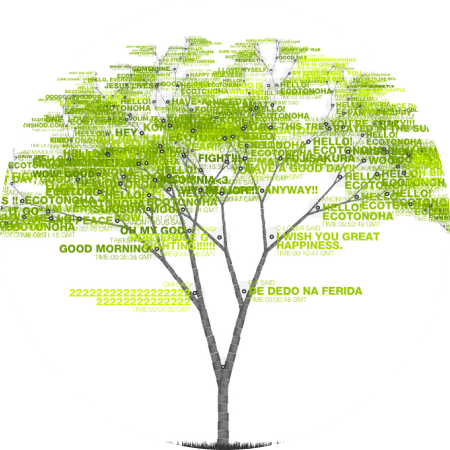
/* While digging through an old hard drive, I found a screenshot from January 29, 2006, 22:48.
Yugop tree.
A fossil from the time when the internet still showed us its bones. */
The tree in the screenshot belonged to Ecotonoha, a digital art and environmental project launched by Japanese technology company NEC in 2003, with its distinctive interactive design created by the legendary web designer Yugo Nakamura. Visitors could write short, 30-character messages that became ‘leaves’ on a growing virtual tree. As the digital tree grew, NEC planted real trees on Kangaroo Island, Australia. The campaign later resulted in 7,423 real trees planted.
Why did it feel revolutionary then?
Because it combined Flash-based generative animation, user input, poetic interface design, and real-world environmental action at a time when most websites were still static pages or basic corporate brochures. Each visitor’s sentence became part of a living visual system: not just a comment box, but a branching, animated, collective artwork.
Technically, the magic was that it made the web feel alive and responsive. Participation was visualized in real time. Words became leaves. Leaves became branches. Branches became a forest.
Somewhere inside it is my own input too, but I can’t find it anymore.
Which feels strangely accurate.
The early social internet promised that every trace would remain visible, connected, locatable. Twenty years later, everything is preserved and almost nothing is findable.
In 2006, that kind of visual structure still felt almost futuristic: the internet as a living organism, people as nodes, thoughts branching outward. The web was shifting from pages you visited to streams you inhabited.
In those early days, a social graph could still look like a tree.
Branches. Roots. Visible connections.
A structure you could zoom into, trace, maybe even understand.
And now, twenty years later, the tree is still there.
We just no longer see it.
We live under the canopy, inside the overgrown forest.
Or maybe it is more like weather now. Less structure, more atmosphere. Less “where am I in this system?” and more “why am I suddenly feeling this?” There is no next page, no boundary, no fixed address. Only a continuous, infinite scroll. You cannot map an infinite stream. You can only float in it.
What struck me is not nostalgia. It is the shift from visible networks to invisible systems.
Back then, the revolutionary thing was:
Look, people are connected.
Now the horrifying thing is:
The connection is being interpreted, ranked, predicted, monetized, and fed back to us before we even notice it.
Digital archeology is strange that way: sometimes you excavate the past and find the present staring back.
The forest remembers us better than we remember ourselves.
We did not lose the tree. We lost the map.
And somewhere in that forest, one small leaf is still mine.
 © Alexandra Mark
 © Alexandra Mark