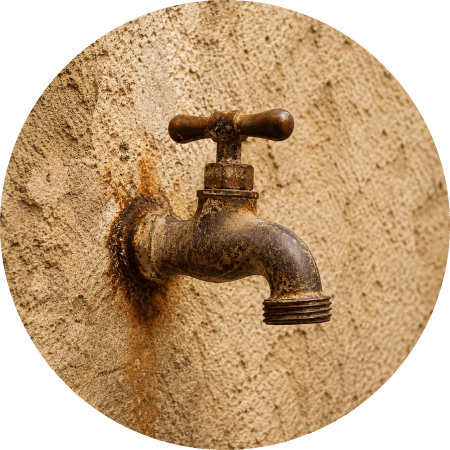
Humidity & Humility
On ownership, impermanence, and the climate between them.
/* We like to believe that ownership means control.
That taking care of things guarantees they will last.
Then reality introduces another variable.
I learnt it the hard way, among boxes and suitcases, somewhere between Europe and the Caribbean. */
Back in Europe, I’d learnt that things lasted if you took care of them.
My grandparents’ homes are a good example. They had furniture from ‘before the war’ (meaning pieces from before the Second World War that had somehow survived and been passed down), ‘after the war’ (meaning bought just after WWII) and ‘a long time ago’ (roughly in the sixties or early seventies).
The chunky armoires looked as though they’d survive even a nuclear disaster. The veneer on that dressing table would keep its ebony colour for another century, although the mirror had acquired a few stains. And that fridge — moody at times, but still working.
Whether things were better made back then is a different discussion altogether.
What mattered was that we believed things should last and behaved accordingly. We maintained them carefully, and they seemed to reward us by quietly resisting time.
I was always torn between two things.
It’s nice to have things with history.
But what if you become their slave?
And what if you become bored with them?
My grandma never changed the living room armoire. I never liked it. It wasn’t about whether the design was outdated. I simply found it depressing to look at the same thing for decades.
Grandpa made it when they got married, so I understand the extra emotional layer. But even that never seemed reason enough to keep it there rather than simply move it to another room and refresh the space where they spent most of their time.
But she never thought of it that way. The armoire entered their life together. It was there. It stayed. And it would stay until the end of their days. Grandma never thought, “Oh, it’s démodé, we should change it.” It was simply reliable. That was enough.
When I started living on my own, most of my things were new. Although I was flexible with occasional changes, makeovers and complete design switches, after some time, I did become a hoarder. I was particularly attached to my books, artworks, and things brought back from my travels.
I took care of things as I had been taught.
They lasted while I changed.
Apartments changed too, but that blue armchair always had to find its place. That brocade curtain had to fit any window. And that drawer had to squeeze in that tiny hallway. Bookshelves were non-negotiable.
Then I moved to another continent. Another climate.
Moving furniture was not an option. I started again from zero.
At first, I missed all my stuff. Then less and less. (Except the books.)
My blue armchair was comfortable. Now I have a better one.
The new bookshelf holds a different collection of books.
The teacup collection is the best I’ve ever had.
I got new things that better reflected my current lifestyle and who I had become.
I took care of them so they could last.
The same equation. The same expectation.
But I hadn’t counted on one variable.
There is another player in this game.
Silent in the background, ever present.
Humidity.
If you haven’t experienced it firsthand and for a prolonged period, you might think I’m exaggerating. Unfortunately, I’m not.
To make matters worse, humidity isn’t acting alone. There’s one more silent destroyer: UV light. This power couple is the ultimate thing slayer.
Stainless, rostfrei, water resistant — that means nothing anymore.
The cushions on the terrace will become six shades paler in six months.
Paintings, unless you give them a protective UV coating, will fade in a year or two.
In less than a year, the new fancy bathroom tap will be rusty and look worse than my grandparents’ garden tap after half a century of exposure to all four seasons.
Don’t even get me started on shoes and accessories.
(Not counting clothes, because fashion, taste and body are changeable.)
Some of these were meant to last you for several seasons at least.
I had boots that went through many snowy, muddy winters and still looked good.
I had a travel bag that had been on countless flights and tossed around in dozens of countries, yet barely showed any wear.
Now I have to throw away several barely used bags each year because they start to fall apart. Sandals and belts literally crumble to dust. Ironically, even that resilient travel bag that had survived the world eventually surrendered here, indoors.
Of course, things can be damaged or lost in all sorts of ways.
A guest accidentally breaks your favourite cup.
A hard drive containing all your archives fails beyond recovery.
The kid decides to use permanent markers on the beige chair.
All of this happens, and that’s okay.
But humidity is sneaky.
That’s what makes it so difficult to argue with.
There is no one to blame.
It constantly reminds me that things can disappear in more than one way.
Not by leaving them behind.
Not by neglect.
Not even because of time.
Here, the elements win.
I accepted the loss of things once.
Then I had to learn another way of losing them.
It was the final lesson in detachment from material things.
This doesn’t mean I no longer want beautiful things. I will not stop getting them. But I will not be quite so sorry when we have to part. And, in a way, I enjoy being forced to make occasional changes to a space that might otherwise remain the same for much longer.
Now, surrounded by things that I know won’t last, I keep thinking of that ugly brown armoire.
Maybe it was exactly the thing that created the sense of stability and that quiet ‘this is home, you’re safe here’.
And there, if only for a while, neither time nor the elements could win.

 © Alexandra Mark